Describe a Friend: Part 2 Cue Card (2026)
Use our AI to get a personalized Band 9 answer and vocabulary for the IELTS Speaking Part 2 Cue Card "Describe a friend".
Start Practicing →The "Describe a friend" or "Describe a good friend" Cue Card is a massive, evergreen IELTS topic in the People category. Examiners hear thousands of students give basic answers like "he is nice and funny." To secure a Band 7+, you need to stand out by using high-level character adjectives and natural collocations like dependable presence, charismatic, and level-headed, while explaining exactly how this person impacts your daily life.
How to Use This Sample Answer
Below is a sample answer for a male student describing his university groupmate. If this matches your current situation, it is perfect for you. But what if you want to describe your childhood best friend? Or a colleague you met at your first job?
Here is the strategy:
Read this sample answer to understand the logical structure of a Band 7+ response.
Use the IELTS Speaking Lab App to instantly generate your own personal answer to this Cue Card, tailored to your real-life friendships.
Part 2 Cue Card and Sample Answer
Describe a friend. You should say:
Who the person is
How and when you met
What you usually do together
And explain why this person is a good friend.
Band 9 Sample Answer
Introduce: I would like to talk about one of my closest mates at university, a guy named David. He is a current classmate of mine in the engineering program, and over the past year, he has become an incredibly dependable presence in my academic and personal life.
Describe: We initially crossed paths during our freshman orientation, but we really bonded when we were randomly assigned to the same project group. Physically, he is quite tall with an athletic build, but personality-wise, he is incredibly level-headed and charismatic. Whenever our group is stressed out about an upcoming deadline, David has this remarkable ability to defuse the tension with his dry, sarcastic sense of humor.
Explain: We spend a massive amount of time together, mostly hitting the books in the library or grabbing a quick coffee between lectures. What makes our dynamic work so well is our mutual respect. When it comes to our study habits, we complement each other perfectly; I tend to focus on the fine details, while he is excellent at seeing the big picture. Outside of class, we often blow off steam by playing basketball or geeking out over new technology.
Add impact: I value his friendship immensely because he is genuinely a stand-up guy. The transition to university was pretty tough for me, being away from my family and my hometown friends, but having a like-minded peer like David has made the whole experience incredibly rewarding. He pushes me to be better, and that is the true mark of a great friend.
This answer uses the IDEA Strategy (Introduce, Describe, Explain, Add impact).
Part 3 Questions and Sample Answers
After you finish your Cue Card, the examiner will ask you deeper questions related to human relationships and society.
1. What makes someone a good friend?
In my opinion, the foundation of any strong friendship is unwavering loyalty and honesty. A true friend is someone who will tell you the hard truth when you need to hear it, but will also support you during your lowest moments. Furthermore, a good friend should be an active listener who fosters a sense of genuine intimacy, rather than just talking about themselves.
2. Are childhood friendships different from adult friendships?
Absolutely. Childhood friendships are often built on proximity and shared history; you are friends simply because you played in the same neighborhood. Adult friendships, however, require much more deliberate effort. Adults tend to bond over common interests, career paths, or shared values. Because adults are busier, their friendships prioritize quality and understanding over constant, daily interaction.
3. How has social media changed the way we make friends?
The digital age has completely transformed socializing. On the positive side, the internet allows us to maintain a surface-level connection with people who live halfway across the world. However, the downside is that it can create a false sense of closeness. People curate perfect online personas, which makes it harder to build deep, authentic relationships in the real world.
4. Is it possible to have too many friends?
I definitely think so. Maintaining deep, meaningful bonds is incredibly time-consuming and requires emotional energy. Human beings simply do not have the capacity to be intimately close with fifty people. When someone has a massive social circle, the vast majority of those people are likely just acquaintances rather than true confidants you can rely on in an emergency.
Key Vocabulary for IELTS Cue Card: Describe a Friend
Here is the complete glossary of the vocabulary used in the answers above, plus extra high-level words relevant to character and relationships.
Acquaintances: (Noun) A person one knows slightly, but who is not a close friend.
Between lectures: (Noun Phrase) The short breaks of free time separating university classes.
Big picture: (Noun Phrase) The overall perspective or objective, not the fine detail.
Blow off steam: (Idiom) To do or say something that helps you get rid of strong feelings or energy.
Charismatic: (Adjective) Exercising a compelling charm which inspires devotion in others.
Common interests: (Noun Phrase) Shared passions, hobbies, or pursuits between two or more people.
Complement each other: (Phrase) To combine in such a way as to enhance or emphasize the qualities of each other or another.
Crossed paths: (Phrase) Met someone by chance.
Defuse the tension: (Phrase) To make a situation less tense, dangerous, or difficult.
Deliberate effort: (Noun Phrase) A conscious, intentional attempt to do something.
Dependable presence: (Noun Phrase) A reliable and consistent person in one's life.
During your lowest moments: (Phrase) In times of severe difficulty, sadness, or depression.
False sense of closeness: (Noun Phrase) A deceptive feeling of intimacy or connection that isn't actually real or deep.
Genuine intimacy: (Noun Phrase) Real, authentic closeness and emotional connection with someone.
Level-headed: (Adjective) Calm and sensible in a crisis or stressful situation.
Like-minded: (Adjective) Having similar tastes, opinions, or values.
Mutual respect: (Noun Phrase) A feeling of admiration shared between two or more people.
Peer: (Noun) A person of the same age, status, or ability as another specified person.
Perfect online personas: (Noun Phrase) Carefully curated, idealized versions of oneself presented on the internet.
Shared history: (Noun Phrase) Experiences and memories that two people have gone through together over time.
Social circle: (Noun Phrase) A group of people who are socially connected.
Stand-up guy: (Noun Phrase) A highly loyal, reliable, and honorable man.
Surface-level connection: (Noun Phrase) A relationship that lacks deep emotional or intellectual engagement.
Time-consuming: (Adjective) Taking a lot of or too much time.
Unwavering loyalty: (Noun Phrase) A strong feeling of support or allegiance that never changes or weakens.
Create Your Own Band 9 Answers
The sample above is great if you want to talk about a university classmate. But your exam answer needs to be authentic to your own life so you do not freeze up or forget your lines.
What if you want to talk about a childhood friend you grew up with? Or a coworker who helped you out?
IELTS Speaking Lab helps you turn your real memories into Band 9 answers.
Select your cue card - Describe a friend.
Input your rough idea (e.g., "My best friend from high school who always makes me laugh").
Get your personalized Band 9 answer instantly, with the perfect vocabulary built in.
Not happy with these answers?
Change the core idea, band level difficulty, length and get a full glossary in our free app!
Start Practicing →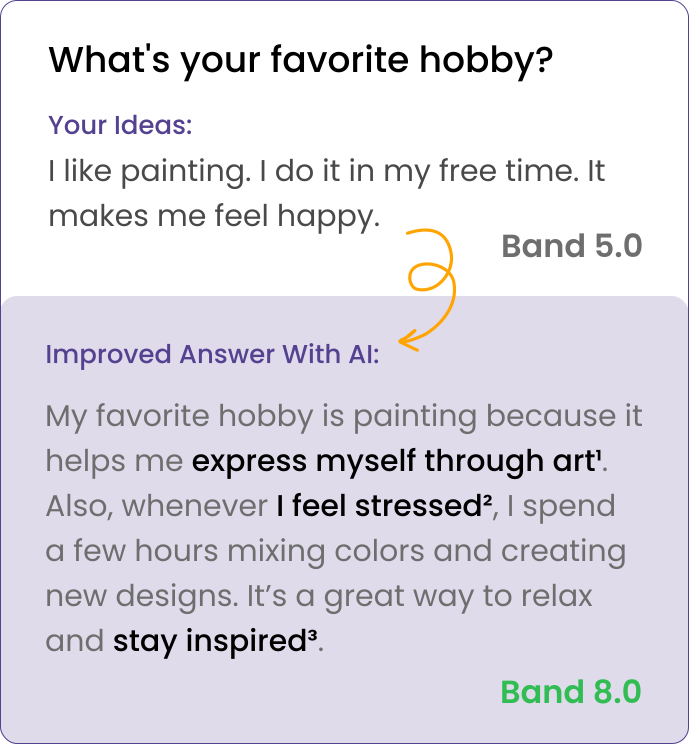
Practice IELTS Speaking answers in our free app
- Build personalized answers that match your target band.
- Turn short replies into fluent answers
- Let examiners fall in love with your answers!
Related Articles
Sample Answers
IELTS Speaking Part 1: Concentration Questions & Answers (Sep-Dec 2026)
Latest Sep-Dec 2026 IELTS Speaking Part 1 questions for Concentration. Read Band 9 sample answers, or use our AI app to turn your own ideas into perfect answers.
Sample Answers
IELTS Speaking Part 1: Jewelry Questions & Band 9 Answers (2026)
Latest Sep-Dec 2026 IELTS Speaking Part 1 questions for Jewelry. Read Band 9 sample answers or generate personal answers using our AI.
Sample Answers
IELTS Speaking Part 1: Colors Questions & Answers (Sep-Dec 2026)
Latest Sep-Dec 2026 IELTS Speaking Part 1 questions for Colors. Read Band 9 sample answers, or use our AI app to turn your own ideas into perfect answers.