Describe Your Dream Job: Part 2 Cue Card (2026)
Use our AI to get a personalized Band 9 answer and vocabulary for the IELTS Speaking Part 2 Cue Card "Describe your dream job".
Start Practicing →The "Describe your dream job" is a classic Cue Card that is still popular in 2026. To achieve Band 7+, you must avoid simply stating a job title and listing basic duties. Instead, you should focus on the lifestyle, the creative challenges, and the personal meaning associated with this career using vocabulary like visual identity, creative freedom, and professional fulfillment.
How to Use This Sample Answer
Below is a sample answer for a creative person who wants to become a Freelance Brand Designer. If this matches your choice, great. But what if you dream of running a specialized coffee shop? Or becoming a digital nomad writer?
So here is the plan:
Read this sample answer to understand the structure of a Band 7+ answer.
Use the IELTS Speaking Lab App to instantly generate your own personal answer to this Cue Card with perfect vocabulary that describes your specific dream job.
Part 2 Cue Card and Sample Answer
Describe a job you would like to have in the future. You should say:
What the job is
What skills you need for this job
What the job involves
And explain why it is your dream job.
Band 9 Sample Answer
Describe: The occupation I have always aspired to is becoming a Freelance Brand Designer. Unlike a general graphic designer who might just make simple logos, a brand designer creates the entire visual identity of a company—everything from the color palette to the typography. I would primarily focus on working with small, ethical startups.
Add detail: This job involves wearing many hats. I would need to be proficient in design technology like Adobe Illustrator and Figma to create high-quality mockups. But beyond the technical skills, I would need strong communication skills to pitch ideas to clients. Since I would be a solopreneur, I would handle my own marketing and accounting, likely working from a studio in my home.
Link to self: This path fits me perfectly because I have a flare for creativity but I hate the rigid structure of a 9-to-5 office. I crave flexibility. Being my own boss means I can set my own rates, which can be quite lucrative if you build a strong reputation. This financial stability is crucial to support my family while maintaining a healthy work-life balance.
Example: For instance, I imagine landing a commission to rebrand a local sustainable bakery. I would spend weeks researching their values, sketching ideas, and finally presenting a comprehensive brand guideline. Seeing my designs on their packaging and storefronts across the internet would be incredibly fulfilling.
This answer uses the DALE Strategy (Describe, Add detail, Link to self, Example).
Part 3 Questions and Sample Answers
After you finish your Cue Card, the examiner will ask you deeper questions related to work and creativity.
1. Do you think AI will replace designers in the future?
I don't think it will replace them, but it will force them to adapt. AI tools can generate images instantly, which helps with brainstorming and mundane tasks. However, design is about storytelling and emotion, which requires a human touch. Designers who use AI to speed up their workflow will thrive, while those who refuse to learn the technology might fall behind.
2. Is it better to go to art school or build a portfolio on your own?
In the creative industry, your portfolio is your bread and butter. Clients rarely ask for a degree; they want to see what you can actually do. While formal study at a university provides a great foundation in theory and networking, self-taught designers often have a more unique style. With so many tutorials available online, a degree is no longer strictly necessary.
3. How has the internet changed the way freelancers find work?
It has completely democratized the industry. In the past, you were limited to local clients. Now, platforms and social media allow you to showcase your work to a global audience. You can be in London and work for a client in Tokyo. However, this also means the market is oversaturated, so you have to work much harder to stand out from the crowd.
4. What are the downsides of being a freelancer?
The biggest downside is the uncertainty. You don't have a guaranteed paycheck at the end of the month, so you have to be very disciplined with your finances. Also, it can be quite lonely. Without colleagues to talk to, you miss out on the social aspect of work. You have to be self-motivated to stay productive without a boss watching over you.
Key Vocabulary for IELTS Cue Card: Dream Job
Here is the complete glossary of the vocabulary used in the answers above, plus extra high-level words relevant to this topic.
A guaranteed paycheck: (Phrase) A fixed amount of money paid regularly to an employee, which freelancers do not have.
Aspire to: (Phrasal Verb) To have a strong desire or ambition to achieve something.
Brainstorming: (Noun) A group or individual creativity technique by which efforts are made to find a conclusion for a specific problem by gathering a list of ideas.
Bread and butter: (Idiom) A person's main source of income; the most important part of a job.
Commission: (Noun) A formal request to produce a special piece of work (like a painting, design, or building) in exchange for payment.
Comprehensive: (Adjective) Complete; including all or nearly all elements or aspects of something.
Democratized: (Verb) Made accessible to everyone; allowing everyone to participate.
Flare for creativity: (Phrase) A natural ability or talent for creating new and original ideas.
Flexibility: (Noun) The quality of bending easily without breaking; in work, the ability to change hours or location easily.
Fulfilling: (Adjective) Making someone feel satisfied or happy because of fully developing their character or abilities.
Landing a commission: (Phrase) Successfully getting a job or project.
Lucrative: (Adjective) Producing a great deal of profit; moneymaking.
Maintaining a healthy work-life balance: (Phrase) Keeping a good division between the time you spend working and the time you spend with family or relaxing.
Mockups: (Noun) A model or replica of a machine or structure, used for instructional or experimental purposes (in design, a draft of the final look).
Oversaturated: (Adjective) Having too much of something; flooded with supply (too many designers, not enough jobs).
Pitch ideas: (Phrase) To present or describe ideas to someone in a persuasive way to get them to buy or accept them.
Portfolio: (Noun) A collection of drawings, documents, or designs that represent a person's work.
Professional fulfillment: (Phrase) The feeling of happiness and satisfaction caused by achieving success in one's career.
Showcase your work to a global audience: (Phrase) To display your projects or skills to people all over the world via the internet.
Solopreneur: (Noun) A person who sets up and runs a business on their own, without partners or employees.
Storytelling: (Noun) The activity of telling or writing stories; in design, using visuals to communicate a message or feeling.
Uncertainty: (Noun) The state of being uncertain; unreliability.
Visual identity: (Phrase) The visible elements of a brand, such as color, form, and shape, which encapsulate and convey the symbolic meanings.
Wearing many hats: (Idiom) To have many different roles or tasks to perform (e.g., being the designer, the accountant, and the marketer).
Create Your Own Band 9 Answers
The answer above is perfect—if you are a creative person who wants to design. But what if you dream of being a specialized surgeon? Or what if you aspire to be a full-stack developer?
Your answers need to be true so that you can easily recall them during a stressful exam.
IELTS Speaking Lab helps you turn your real ideas into Band 9 answers.
Select your cue card - Describe a dream job.
Input your rough idea (e.g., "I want to be a full-stack developer").
Get personalized Band 9 answer instantly, with the perfect vocabulary for your story.
Not happy with these answers?
Change the core idea, band level difficulty, length and get a full glossary in our free app!
Start Practicing →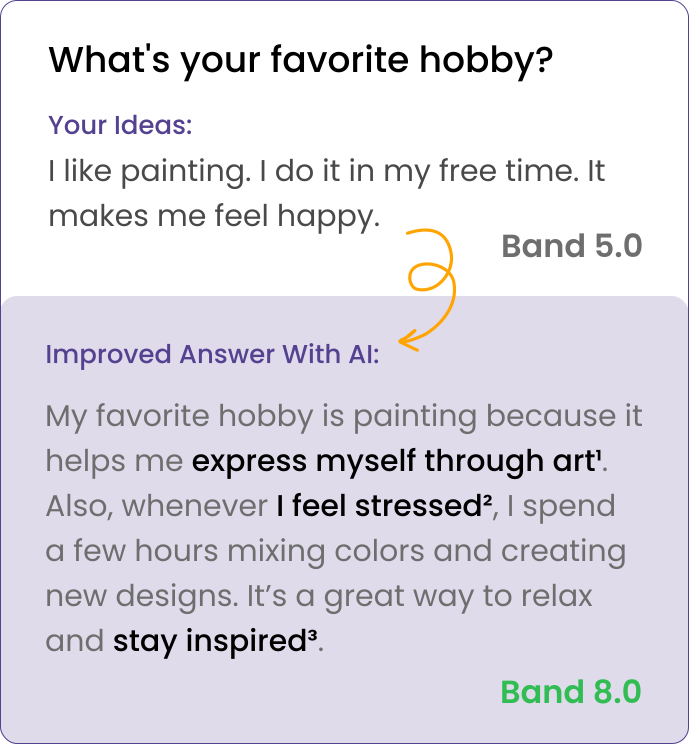
Practice IELTS Speaking answers in our free app
- Build personalized answers that match your target band.
- Turn short replies into fluent answers
- Let examiners fall in love with your answers!
Related Articles
Sample Answers
IELTS Speaking Part 1: Concentration Questions & Answers (Sep-Dec 2026)
Latest Sep-Dec 2026 IELTS Speaking Part 1 questions for Concentration. Read Band 9 sample answers, or use our AI app to turn your own ideas into perfect answers.
Sample Answers
IELTS Speaking Part 1: Jewelry Questions & Band 9 Answers (2026)
Latest Sep-Dec 2026 IELTS Speaking Part 1 questions for Jewelry. Read Band 9 sample answers or generate personal answers using our AI.
Sample Answers
IELTS Speaking Part 1: Colors Questions & Answers (Sep-Dec 2026)
Latest Sep-Dec 2026 IELTS Speaking Part 1 questions for Colors. Read Band 9 sample answers, or use our AI app to turn your own ideas into perfect answers.